Session 1

The Future of Robotics

Machines That Move, Sense, and Adapt

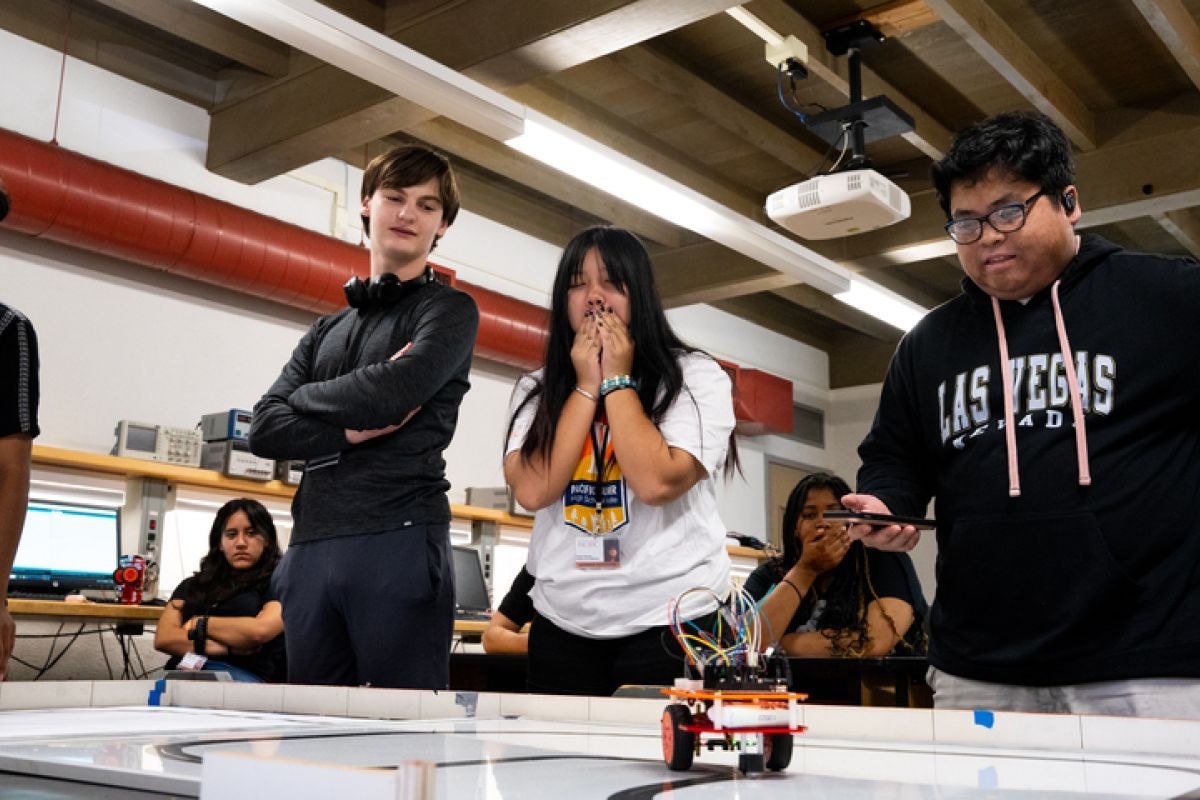
Can you teach a robot to walk, grab objects, or accomplish complex tasks? Explore the fascinating world of next-generation robotics, from humanoid and four-legged robots to robotic arms and intelligent machines. Through hands-on engineering and programming challenges, discover how robots use sensors, motors, and code to move, interact with their surroundings, and perform real-world tasks. Experience the technology that's shaping the future of robotics!

Curriculum

You will learn from constructing circuits to test sensors and programming (C/C++, or python) to control the robot. The mobile robotics course is a fun hands-on experience that includes:

  • A statically stable robot frame to learn robot mechanisms
  • DC-motors with encoder sensors to measure traveling distance
  • An Arduino (microcontroller)-based programming via a computer-based IDE (integrated development environment)
  • Hardware that instructs the robot to execute commands to move the robot autonomously
  • A breadboard for constructing circuits to learn electronics for robotic systems
mobile robots
Planned Topics

The course has multiple sections using different sensors for robots to:

  • Navigate different terrains including flat floor to Mars-like terrain
  • Track lines (black or white)
  • Detect obstacles
  • Follow objects
  • Use camera vision and image processing technologies
  • Be controlled using remote IR controllers, joysticks or smartphones

Each section includes lab sessions to explore scientific, physics-based learning, to help students understand what goes on behind the scenes when a robot moves.


Summer Institute Logo
Dongbin Lee
Faculty Lead
Don Lee

Assistant Professor, ECPE (SOECS)

Ph.D., Clemson University, 2009

Dr. Dongbin "Don" Lee is an assistant professor in the ECPE department in the School of Engineering and Computer Science at Pacific. He has expertise and interest in uncrewed robotic systems with control systems and AI/deep/machine learning techniques in application to self-driving autonomous vehicles, smart manufacturing, efficient solar-power systems, farmers-centered sustainable precision agriculture tech, vector control, EOD, drones and ATVs. Dr. Lee advises the solar-powered racing car club, builds student-centered projects at Pacific, advises student competition teams including robotics and supports STEM/MESA outreach. In addition, he was the recipient of several Oregon NASA space grants between 2017 and 2022.